As we made our way up Skull Creek last week on our way back from Daufuskie Island to Beaufort, I noticed something unusual about a power cruiser coming up behind us. It had just passed under the main route 278 bridge (officially the J. Wilton Graves Bridge) which connects the mainland to Hilton Head. Was the boat speeding and making a hard turn or was it something else?
Upon closer observation, it appeared to be badly listing to starboard and not traveling all that fast. It seemed to need assistance, but a Sea Tow boat passed just a few yards away from it. I don’t know if there was some shouted or signaled conversation between the boats, but there was none on Channel 16.
The Sea Tow boat continued south, the listing cruiser north, eventually catching up to us. The VHF crackled as a boat hailed us and politely advised they would be overtaking us on our port. I asked the captain if he was the listing vessel, and if he required any assistance. “Yes, that’s us”, he said in a somewhat tired voice, “and we don’t require any assistance, we just need to get up Skull Creek.” I slowed to a crawl to allow him a safer pass and captured some of video below.
The captain’s response seemed to indicate this was a stable condition, but the water line as we observed it seemed to indicate it was getting worse. As another large cruiser heading southbound passed the vessel, its wake had a serious impact on the boat’s stability. It veered toward port, a definite no-no in a narrow channel, but fortunately there was not another boat close behind the first. As we passed by in the channel some of our crew thought the captain might be making for the shoreline to beach the bow into the soft rising mud during the low tide. This was dismissed a few minutes later when the captain announced he would be dropping anchor in the middle of the channel. Apparently the vessel was restricted in its ability to maneuver. Perhaps it had lost power or steerage.
The boat was now obviously a serious hazard to navigation, and I issued a Securite call to notify other boaters of its condition and location. Within a few minutes a local DNR boat with two officers and a diver was on the scene discussing the situation with the captain. There was then radio chatter with Sea Tow and the captain indicated he was in fact a member and the local Sea Tow operator indicated he did have an auxiliary pump on board. If this was the case, why didn’t they communicate earlier when they passed within earshot?
I’d like to think that this story has a happy ending, but I don’t have a way of knowing the who, what or why of this situation. For that reason I have excluded the name of the subject vessel and offer this for your consideration.
Lessons Learned:
Alert other boaters and rescue/safety personnel if you have serious operating issues – this includes if you are not fully maneuverable, sensitive to wakes, and taking on water in an amount that is a clear danger for sinking or capsizing. Advise number of souls on board and don life jackets. If you see an unsafe situation on another boat, say something, even if the other captain assures you everything is fine.
Water below decks is heavy and unstable – a sudden turn or small wake can push water even further to one side, creating a serious capsizing hazard. “Floating Condo” (high profile, shallow draft) boat designs are not that stable in normal conditions. When they are seriously overloaded they are prone to capsizing as this horrible loss-of-life incident in Long Island Sound revealed on the Fourth of July, 2012.
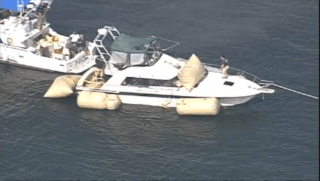
The captain reported the vessel started to turn sharply, a turn from which it could not recover and capsized. Three young children were trapped below decks and drowned. How close the Skull Creek vessel came to capsizing is unknown, but the sudden turning in the video is consistent.
Regular below-decks inspections – check for leakage from through-hull fittings and hoses, plus shaft seals and stuffing boxes. Test bilge operation and emergency manual pump.
Knowledge – learn the rules of the road regarding safety and navigation. Get to know your boat inside and out, learn survival repairs, and know who to contact when you have a problem you can’t handle. If you haven’t paid to keep up your boat towing and assistance insurance, renew it today, before you have an incident.
Anything you would like to add to the list? Please put in the reply box below.
For your amusement only:
The captions on the slideshow are inspired by this number. Follow the direct link to this song and don’t forget to download the laughing pirates songs which includes sea shanties, sailing songs, and rock classics . You can click on the playlist below to see and hear samples of the top 100 songs. To connect to the full list, Spotify service requires sign-up but is free for listening.
The Clash – Should I Stay Or Should I Go (Audio) Listen On Spotify – http://smarturl.it/TheClashTT
Communication is critical and you need sharp thinking skills when your vessel and crew are in jeopardy. This classic will help you laugh after a hard day on the water.
 the laughing pirates